Potential Earnings
£52,104.41
Heads up! The following website content has been accessed through a temporary preview link. The URL contains one a preview token which means the URL is temporary and will eventually expire.
The current URL this page has been accessed with is not for external distribution or usage. It is for previewing or viewing content that is otherwise classified as draft or not published externally yet. The public link to this page should be used instead for distribution:
https://www.nottinghamcollege.ac.uk/courses/applied-education-studies-ba-hons-degree-level-6-full-time
Note: The content available through this preview link may not currently be published live until it has received sign off or approval. If you have any questions please contact .

This degree programme is a great option for anyone who is interested in working in the education sector but may be unsure which career route they would like to take.
It has been designed to develop knowledge, understanding and critical reflection of the contemporary educational landscape through the lens of Early Years, Compulsory Education and Vocational/Post Compulsory settings.
The course seeks to prepare graduates for a diverse range of careers within educational settings such as:
If you already hold a related Level 5 qualification (such as an HND or Foundation Degree), you can join the programme directly at Stage 3 (Level 6) and top-up to a BA (Hons) degree over one academic year.
Year 1 modules
AES401: Methods of Enquiry
This module will provide a clear introduction to educational research, including the importance of research and how it impacts everyday life.
You will also develop critical reading skills and will develop skills on how to reference accurately and why it is important.
Another key part of this module is for students to gain an understanding of research ethics and the importance of this.
AES402: Education in Context
This module will provide you with opportunities to explore different perspectives on learning and draw comparisons with international teaching and learning approaches, work-based learning, digital learning and educational philosophies.
You will examine curricula across the age ranges and explore the influence of culture, politics and social norms.
AES403: Theories of Learning
This module examines in detail the theories of learning, including those of Bandura, Piaget, Skinner, Kolb, Moyles, Athey and Rosenshine.
You will evaluate the ideas and think critically about the evidence that has led to these theories. You will also make links between theories and the outcomes of learning frameworks, for example, the National Curriculum and Vocational courses.
AES404: Education for All
This module explores the structural inequalities within education, including legislation, social and cultural movements, and global and national events.
The module examines the origins of barriers and the impact of relevant legislation to address the inequalities within education. Particular focus is on groups who are likely to underperform, examining the impact of gender, race, and social class on education performance.
AES405: Safeguarding
This module examines the statutory requirements, legislation, different agencies and the role of the professional in education in relation to safeguarding and protecting children and vulnerable people. It examines high-profile pivotal cases concerning children and vulnerable adults.
This module aims to develop your understanding of the duty of professionals to work together to promote the welfare of children.
Year 2 modules
AESO501: Early Years Education
This is an optional unit
This module supports you in gaining a deeper insight into the management of the curriculum and consider alternative curriculum models and their impact on children’s learning and development.
You will explore the development of the Early Years sector in England, the United Kingdom and abroad and examine how key theories of how children learn have influenced them.
AESO502: Post-Compulsory Education and Training
This is an optional unit
This module explores post-compulsory education and training within the UK in detail. You will examine the history of post-compulsory education and its diverse function in society, with a focus on the different parts that make up post-compulsory education.
This module will also support your understanding of the key drivers and the impact on those who use the sector through academic, vocational, technical and apprenticeship qualifications.
AESO503: Teaching, Learning and Assessment
This is an optional unit
This module aims to support you in exploring a range of areas within teaching, learning, and assessment.
During this module, you will develop an understanding of different learning theories and consider how these might impact teaching, learning, and assessment of different age groups and the application of curriculum and frameworks.
AES504: Research in Education
This module links to the Methods of Enquiry module in year one.
The module aims to encourage you to develop your own research skills both in terms of researching a topic and in understanding data collection for research in education.
As part of this module, you will also consider the ethical challenges of conducting research in education and how they can design ethical research.
AES505: Dismantling Barriers to Education
This module explores the complexity of Neurodiversity and its potential impact on learning.
You will evaluate theories regarding Neurodiversity and evaluate strategies which can be used to support individuals in education.
You will also, as part of this module, examine relevant legislation and frameworks that underpin practice, and professional thinking will be interlinked with each aspect studied.
Year 3 modules
AES601: Contemporary Issues in Education
This module will provide you with a wide range of opportunities to explore issues in contemporary education. These issues will consider cultural, social and political influences and how these influences affect key stakeholders within education.
Within this module, you will also gain a deepening understanding of how historical ideas and government policy affects education in a range of contexts. You will be able and supported to critically analyse how these issues affect education practice and why educationalists should be aware of these issues in contemporary education.
AES602: Dissertation
This module is the final module of the course.
This module will also provide you with the opportunity to explore a range of issues in contemporary education in far more detail than in AES601. To do this, you will conduct your own research and critically analyse literature and findings.
As part of AES602: Dissertation, you will take part in primary or secondary research to explore an issue that you are personally interested in. Alongside this, you will also consider the ethical implications of educational research and how these considerations affect the use of different methods.
Timetable (subject to change)
The current timetable is as follows but this is subject to change:
Please note: Some classes may be delivered online.
Useful links:
Nottingham College is proud to have been awarded the Teaching Excellence Framework Bronze Award for high quality student experience and outcomes. You can read more about this on the Office for Students website.
3 years
Level 6 Bachelor of Arts (Honours) in Applied Education Practice - validated by The Open University.
A mixture of traditional and innovative assessment methods will be used, including individual and group presentations, discussions, report writing, case studies, presentations, research and project work, reflective journals and work-based projects.
Graduates will be well-placed for careers in a wide range of educational settings in the public, private and voluntary sectors.
The programme offers an excellent foundation for career progression to more senior educational roles. It can also provide a route into training and consultancy, youth and community work, local government, play work, speech therapy, social work, offender learning and day care management.
Other possible careers could include: special educational needs coordinator (SENCO), nursery manager, family support manager, youth leader, community liaison officer, careers adviser, personal tutor, mentor or behavioural support manager.
Please note: this programme does not qualify you as a teacher. However, the qualification is an excellent route towards Qualified Teacher Status (QTS) via a Postgraduate Certificate in Education (PGCE), or other postgraduate study options.

Nottingham College is approved by The Open University as an appropriate organisation to offer higher education programmes leading to Open University validated awards.
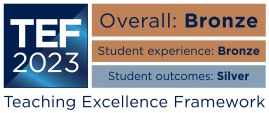
The TEF is a national scheme run by the Office for Students (OfS) that aims to encourage higher education providers to improve and deliver excellence in the areas that students care about the most: teaching, learning and achieving positive outcomes from their studies.
Select career:
Potential Earnings
£52,104.41
Average Earnings
£35,318.57
Source: Office for National Statistics' Annual Survey of Hours and Earnings (ASHE).
The number of job postings in this career for previous years starting from 2023, the current year and projections for future years until 2034.
Sources: The Labour Force Survey (LFS), Working Futures (projections) data, and Business Register and Employment Survey (BRES).
Teaching and Lecturing
Economic data for careers is provided by Lightcast and also available through our Career Coach app. Job postings, employment and earnings information is represented at the regional level for the East Midlands.