Potential Earnings
£46,377.42
Heads up! The following website content has been accessed through a temporary preview link. The URL contains one a preview token which means the URL is temporary and will eventually expire.
The current URL this page has been accessed with is not for external distribution or usage. It is for previewing or viewing content that is otherwise classified as draft or not published externally yet. The public link to this page should be used instead for distribution:
https://www.nottinghamcollege.ac.uk/courses/photographic-practice-bsc-hons-degree-level-6-full-time
Note: The content available through this preview link may not currently be published live until it has received sign off or approval. If you have any questions please contact .

The BA (Hons) degree in Photographic Practice is designed to enable you to build the skills to work effectively as a professional as a freelancer or in the creative industries.
You'll develop a detailed understanding of the technical aspects of photography work including units on studio practice, sports photography, photo journalism and product photography. You will develop your understanding of the use of software such as Photoshop throughout. You will also learn how to manage a business effectively – through units that look at managing finances and working with customers.
Crucially, you will be given the skills and understanding to use digital marketing in creating your own online presence and also explore how this is used by a wide range of employers and organisations. As a result you will be able to use your photographic talents in this rapidly-developing area.
The programme will be delivered at our ultra-modern City Hub campus in Nottingham City Centre, providing access to professional industry-standard equipment, studio spaces and software such as Adobe Creative Suite. You'll also have numerous opportunities to engage and collaborate with other students aiming to get into the creative industries and work in response to live industry briefs.
What you will cover:
Year 1 (Level 4) is designed to provide clear foundations on which to build skills in both practical photography and the concepts behind it.
You will undertake practical units in camera, editing and studio technology whilst studying ideas and concepts in analysing visual imagery, interpreting narratives and understanding audiences.
Indicative Year 1 modules:
Year 2 (Level 5) gives the chance to continue to build and develop skills in specialist areas of photography and exhibiting your work.
Indicative Year 2 modules:
Year 3 (Level 6) gets you ready to launch your photography career with units designed to give you the ability to exhibit, pitch for work, build a portfolio and build your own brand.
Indicative Year 3 modules:
Timetable (subject to change)
The current timetable is as follows but this is subject to change:
Please note: Some classes may be delivered online.
Useful links:
Nottingham College is proud to have been awarded the Teaching Excellence Framework Bronze Award for high quality student experience and outcomes. You can read more about this on the Office for Students website.
3 years
BA (Hons) Degree in Photographic Practice validated by The Open University
We expect applicants to be working at (or to demonstrate competency at) Level 2 or above in English/literacy and maths/numeracy. We accept GCSE passes in English Language and maths at Grades 9 to 4 (previously A* to C).
Applicants must also have a minimum of 64 UCAS points from study at Level 3:
Other combinations of qualifications and experience will also be considered, as will Level 3 qualifications not currently listed on the UCAS tariff.
Mature applicants not meeting the standard entry criteria but with relevant industry or life experience are very welcome to apply.
A mixture of traditional and innovative assessment methods will be used, including individual and group presentations, discussions, report writing, case studies, presentations, research and project work, examinations, reflective journals and work-based projects.
Graduates will be well-equipped to progress to postgraduate study or seek work in a variety of creative roles. Many photographers work in advertising, media, fashion, sports, weddings, and more! Possible careers include: photographer, sports photographer, fashion photographer, press photographer, picture editor, exhibition curator, visual merchandiser, videographer, retoucher, digital marketeer, photo-journalist, blogger or teacher.

Nottingham College is approved by The Open University as an appropriate organisation to offer higher education programmes leading to Open University validated awards.
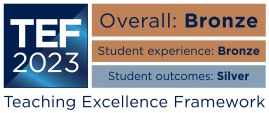
The TEF is a national scheme run by the Office for Students (OfS) that aims to encourage higher education providers to improve and deliver excellence in the areas that students care about the most: teaching, learning and achieving positive outcomes from their studies.

Potential Earnings
£46,377.42
Average Earnings
£26,848.07
Source: Office for National Statistics' Annual Survey of Hours and Earnings (ASHE).
The number of job postings in this career for previous years starting from 2023, the current year and projections for future years until 2034.
Sources: The Labour Force Survey (LFS), Working Futures (projections) data, and Business Register and Employment Survey (BRES).
Art, Performance and Design
Media, Publishing and Information Services
Active Learning
Monitoring
Active Listening
Reading Comprehension
Critical Thinking
Economic data for careers is provided by Lightcast and also available through our Career Coach app. Job postings, employment and earnings information is represented at the regional level for the East Midlands.
Course Area:
Student Type:
Course Type:
Full-time University Level course
Course Area:
Student Type:
Course Type:
Full-time University Level course