

A Level Physics
Key details
- Student types
- A Levels16 - 18 courses
- Course type
-
A Level course
An academic qualification typically taken over two years, focused on specific subjects (usually 3 or 4) and commonly used for progression onto university.
- Course level
-
Level 3
Not sure what this course level means? Use our course level explainer to help guide you through the different levels.
- Start date
- Location
- High Pavement Sixth Form Chaucer Street, Nottingham, NG1 5LP
- Course code
- Parent course code:C000450 Child course code: Q000512
Apply now to study an A Level Programme in 2027/28
You will select your individual subjects when you complete the application.
Apply nowCourse introduction
Studying physics gives you a fascinating insight into the universe, looking in depth at how it came into existence and the scientific principles which govern our world.
This is a challenging but very rewarding course for anyone who enjoys problem solving and wants answers to the big questions about space, time, matter and energy.
As a student of this subject, you will have free access to an online platform called Uplearn to support your studies.
To ensure you’re fully geared up to succeed in physics, it’s expected you’ll also be studying A Level Maths. A Level Computer Science and Chemistry are good matches with physics and provide many routes after A Levels.
You will use maths skills and scientific reasoning to find answers to your questions about how the world works. This exciting and challenging course is highly regarded by universities and future employers.
Year 1:
- Mechanics and Materials
- Particles and Radiation
- Waves and Optics
- Electricity
Year 2:
- Further Mechanics and Thermal Physics
- Fields (Gravitational, Electric & Magnetic)
- Electromagnetic Induction
- Radiation
- Option (Often Astrophysics)
Required Practicals:
- Year 1: 6
- Year 2: 6
These are assessed over the two year period and are awarded at either “Pass” or “Fail” and are awarded independently of the A Level. Some universities require a “Pass” as part of the entry requirements.
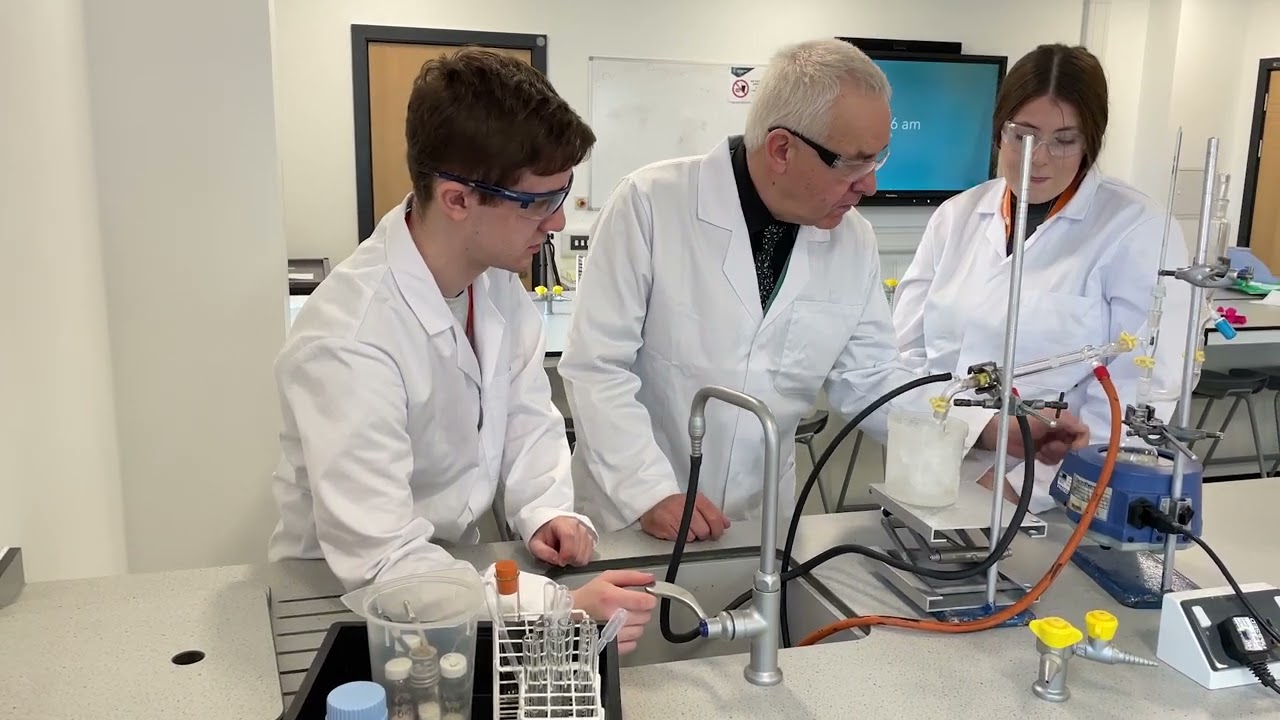
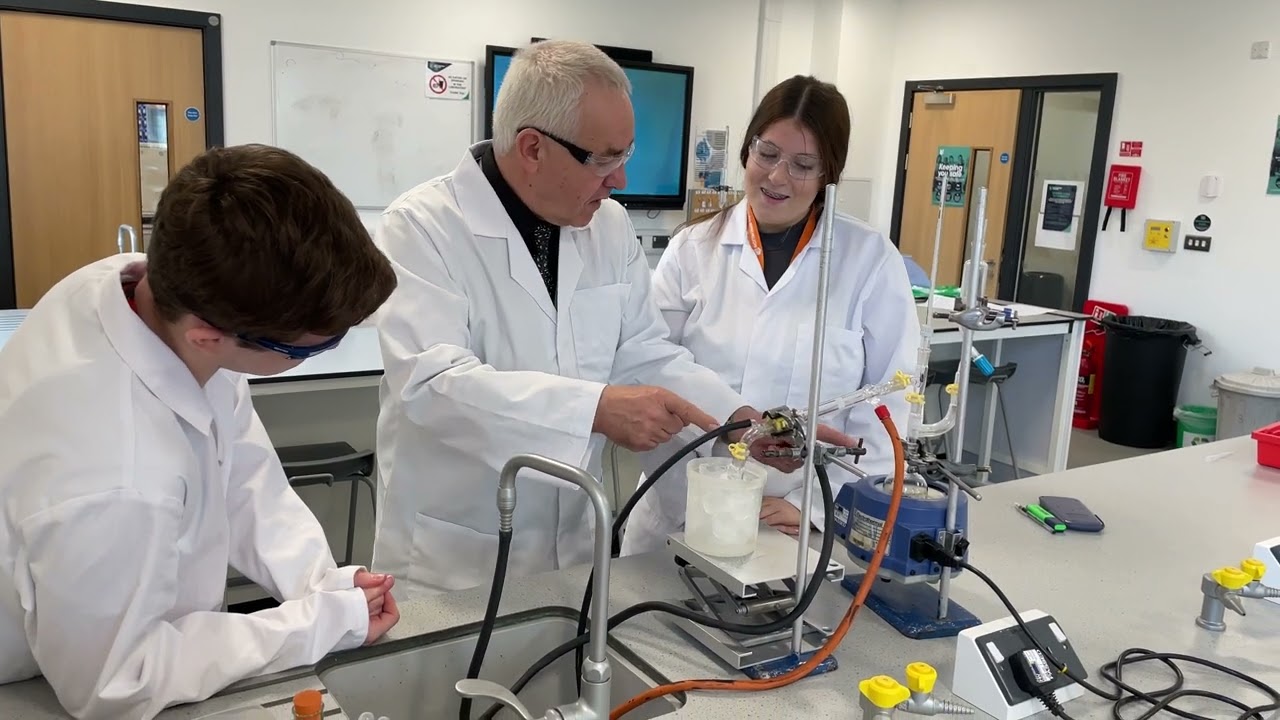
The course is around 80% theory and 20% practical, as the exams are theory based, aside from the required practical assessments, which sit separate from the A Level.
You will study this course alongside 2 or 3 other A Levels and you will be able to select your chosen subjects when you apply online.
While it is not a requirement to take A-Level Maths alongside A-Level Physics, it is highly recommended. If not doing A-Level Maths, a discussion will be needed with a Physics teacher or a member of the careers team prior to enrolment. Students are most successful when they take this alongside another science and/or Maths.

You will be encouraged to participate in a 30-hour work placement while you are studying.
Read moreCourse information
2 years
AQA A Level Physics
- To study 3 A Levels you’ll need at least 5 GCSE’s at grades 9-4 including GCSE English at grade 4 or above and Maths at grade 6 or above.
- To study 4 A Levels you’ll need at least 6 GCSE’s at grades 9-7 including GCSE English and Maths at grade 7 or above.
- One of your GCSEs must be a Grade 6 or above in GCSE Physics or GCSE Combined Science: Trilogy
- If not studying A Level Maths, discussion and approval by a physics tutor will be necessary
The following qualifications are NOT accepted:
- GCSE Applied Science
- GCSE Combined Science: Synergy
- BTEC Science
The programme of study is for 2 years, and you will be expected to be achieving a minimum of grade D in all subject assessments by the end of year 1 to progress to your 2nd year.
Applicants with predicted GCSE grades 1 or 2 points below the entry requirement for an A Level:
If your predicted grades do not meet the entry requirements for either 1 or 2 of your chosen A Level subject choices, don’t worry we will still make you a conditional offer. We advise that you think about a second choice of course as a back-up plan. You can meet with us for a supportive, friendly and impartial discussion to look at other courses that Nottingham College has to offer. For more information contact High Pavement Sixth Form admissions by telephone on 0115 9100 100 or email at feadmissions@nottinghamcollege.ac.uk
There are three 2 hour papers:
- Paper 1 – All of first year + Further Mechanics
- Paper 2 – Rest of year 2
- Paper 3 – Practicals and Option
Students need to complete the practical endorsement which comprises 12 required practicals in the laboratory – students can gain a pass/fail for this.
Physics is a very versatile A-Level as it can lead to many different areas.
Degree: Mathematics, Physics, Mathematical Physics, Engineering, Aerodynamics, Architecture, any other degree that requires logical thought.
Degree Apprenticeship: Engineering based.
Careers: Astronomer, Clinical Scientist, Lecturer, Nanotechnologist, Radiation Protection Practitioner, Research Scientist, Teacher, Sound Engineer, Data Analyst, Nuclear Engineer, Operational Researcher, Patent Attorney, Software Engineer, Telecommunications Researcher.
You will need:
- Folders to keep work in order
- Scientific calculator
- Text books:
- Any AQA Alevel physics textbook will be suitable. However we use Oxford for year 1 and Hodder for Year 2.
Students aged 16-18 don't have to pay tuition fees.
If you are an EU/EEA or Swiss National, please visit our EU Settled Status scheme page for more information.
Video gallery


Careers related to this course
Physical Scientists
Potential Earnings
£59,995.67
Average Earnings
£34,343.48
Source: Office for National Statistics' Annual Survey of Hours and Earnings (ASHE).
Employment opportunities
The number of job postings in this career for previous years starting from 2023, the current year and projections for future years until 2034.
Sources: The Labour Force Survey (LFS), Working Futures (projections) data, and Business Register and Employment Survey (BRES).
Pathways
Natural Sciences
People in these occupations observe the natural order, formulate theories, run tests, and conduct experiments.
Skills
Science
Using scientific rules and methods to solve problems.
Mathematics
Using mathematics to solve problems.
Critical Thinking
Using logic and reasoning to identify the strengths and weaknesses of alternative solutions, conclusions or approaches to problems.
Reading Comprehension
Understanding written sentences and paragraphs in work related documents.
Active Learning
Understanding the implications of new information for both current and future problem-solving and decision-making.
Economic data for careers is provided by Lightcast and also available through our Career Coach app. Job postings, employment and earnings information is represented at the regional level for the East Midlands.
Related courses
Applied/ Biomedical/ Analytical and Forensic Science (Level 3 BTEC Extended Diploma) - Full-time
Course Area:
Student Types:
Course Type:
Full-time Further Education course