
A Level Chemistry
Key details
- Student types
- A Levels16 - 18 courses
- Course type
-
A Level course
An academic qualification typically taken over two years, focused on specific subjects (usually 3 or 4) and commonly used for progression onto university.
- Course level
-
Level 3
Not sure what this course level means? Use our course level explainer to help guide you through the different levels.
- Start date
- Location
- High Pavement Sixth Form Chaucer Street, Nottingham, NG1 5LP
- Course code
- Parent course code:C000450 Child course code: Q000525
Apply now to study an A Level Programme in 2027/28
You will select your individual subjects when you complete the application.
Apply nowCourse introduction
Chemistry is the study of the composition, structure, properties and change of the matter which makes up our world. You will study the world right down to its molecular and atomic structure, discovering more about the elements and compounds which surround us in our daily lives.
Cooking is chemistry. Everything you can touch or taste or smell is a chemical. Chemistry explains why detergent works better in hot water and how one pain killer will be better than another if you’ve got a headache. It enables you to understand the world around you on a deeper level.
Famous chemists include Nobel Prize winning Marie Curie who discovered Radium and Polonium, Louis Pasteur who created early vaccines for anthrax and rabies and Alfred Nobel who invented dynamite and went on to give his name to one of the most prestigious prizes in the world.
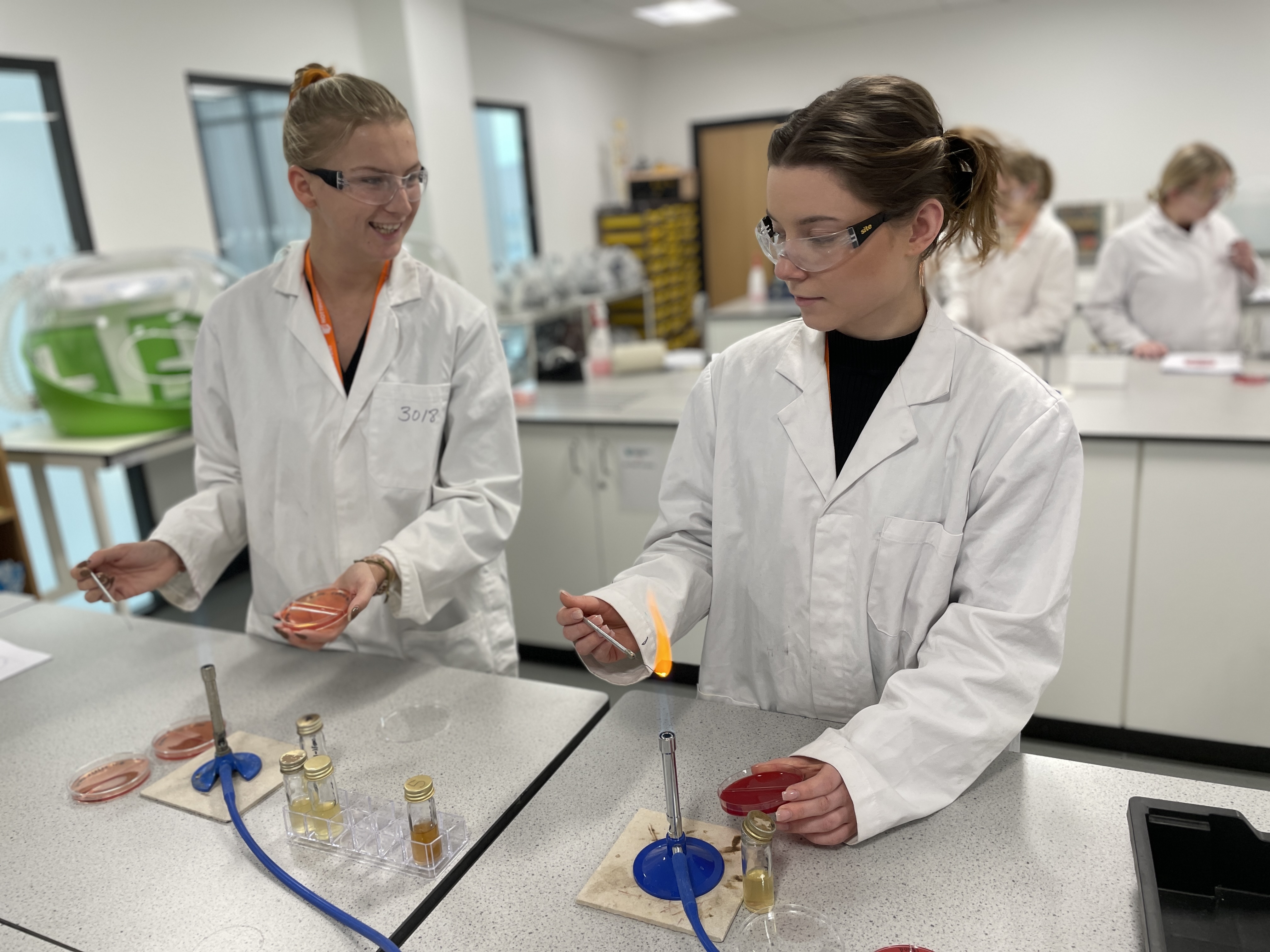
This course will give you a great theoretical base, but will also cover the practical application of chemistry in our everyday lives.
As a student of this subject, you will have free access to an online platform called Uplearn to support your studies.
You will study this course alongside 2 or 3 other A Levels and you will be able to select your chosen subjects when you apply online.
Topics include:
- General chemistry
- Inorganic chemistry
- Organic chemistry
- Physical chemistry
- Analytical chemistry
- and many more advanced topics
Students are most successful when they take this alongside another science and/or Maths.

You will be encouraged to participate in a 30-hour work placement while you are studying.
Read moreCourse information
2 years
AQA A Level Chemistry
To study 3 A Levels, including A level Chemistry, you’ll need at least 5 GCSE’s at grades 9-4 including GCSE English at grade 4 or above and Maths at grade 6 or above.
To study 4 A Levels you’ll need at least 6 GCSE’s at grades 9-7 including GCSE English and Maths at grade 7 or above.
One of your GCSEs must be a Grade 6 or above in GCSE Maths plus Grade 6 or above in GCSE Chemistry. This includes a 6/6 in Combined Science/Science Trilogy.
The following qualifications are NOT accepted:
- GCSE Applied Science
- GCSE Combined Science: Synergy
- BTEC Science
If you are choosing to study A Level Chemistry and do not wish to study A Level Biology or A Level Physics alongside, you will need to discuss this with a chemistry tutor before enrolling. You can choose any A Level combination, but it is strongly recommended that you take A Level Chemistry alongside another science or maths-based subject.
There will be three written papers of two hours duration.
Students need to complete the practical endorsement which comprises 12 required practicals in the laboratory – students can gain a pass/fail for this.
You could progress to a related higher education course such as medicine, agriculture, materials technology, energy, pharmacy, physiotherapy or chemical biochemistry.
There are also a lot of careers open to you such as:
- Dentist
- Physiotherapist
- Doctor
- Forensic scientist
- Biochemist
Students aged 16-18 don't have to pay tuition fees.
If you are an EU/EEA or Swiss National, please visit our EU Settled Status scheme page for more information.


Video gallery


Careers related to this course
Select career:
Chemical Scientists
Potential Earnings
£58,507.51
Average Earnings
£35,169.83
Source: Office for National Statistics' Annual Survey of Hours and Earnings (ASHE).
Employment opportunities
The number of job postings in this career for previous years starting from 2023, the current year and projections for future years until 2034.
Sources: The Labour Force Survey (LFS), Working Futures (projections) data, and Business Register and Employment Survey (BRES).
Pathways
Medicine, Dentistry and Nursing
People in these occupations diagnose, assess, and treat health problems, operate medical technology, and care for patients.
Natural Sciences
People in these occupations observe the natural order, formulate theories, run tests, and conduct experiments.
Engineering
People in these occupations use scientific principles to solve practical problems across a variety of engineering disciplines: civil, chemical, mechanical, etc.
Skills
Reading Comprehension
Understanding written sentences and paragraphs in work related documents.
Science
Using scientific rules and methods to solve problems.
Active Learning
Understanding the implications of new information for both current and future problem-solving and decision-making.
Monitoring
Monitoring/Assessing performance of yourself, other individuals, or organizations to make improvements or take corrective action.
Critical Thinking
Using logic and reasoning to identify the strengths and weaknesses of alternative solutions, conclusions or approaches to problems.
Economic data for careers is provided by Lightcast and also available through our Career Coach app. Job postings, employment and earnings information is represented at the regional level for the East Midlands.
Related courses
Applied/ Biomedical/ Analytical and Forensic Science (Level 3 BTEC Extended Diploma) - Full-time
Course Area:
Student Types:
Course Type:
Full-time Further Education course