
HNC Fine Art (Level 4) - Full-time
Key details
- Course area
- Art and Design
- Student type
- University Level
- Course type
-
Full-time University Level course
A higher‑education programme studied as your main commitment, typically requiring a full weekly timetable and leading to qualifications such as foundation degrees, HNDs, or bachelor’s-level awards.
- Course level
-
Level 4
Not sure what this course level means? Use our course level explainer to help guide you through the different levels.
- Start date
- Time
- 9:00 am - 4:15 pm
- Location
- 25 Stoney Street 25 Stoney Street, Nottingham, NG1 1LP
- Fees
The tuition fee is per year.
Various bursaries are available for some Higher Education courses.
- £8,250.00
- Course code
- Parent course code:C060195 Child course code: Q060196
- UCAS course code
- ART1
- UCAS institution code
- N30
Course introduction
This new course embraces a full range of disciplines, reflecting the diversity of studio-based creativity and critical thinking essential to Fine Art practice today.
This a highly creative interdisciplinary course which explores traditional and contemporary fine art practices.
Whether you work with physical materials or prefer a more conceptual approach, we’ll encourage you to experiment with a wide range of materials, methods, and processes, such as drawing, painting, ceramics, textiles, sculpture, printmaking, illustration, photography, installation, performance and digital technology.
This new course is currently subject to validation with our first students planned for September 2026.
About the course:
Designed to reflect the demands of the creative industries and the flexibility needed in modern life, this course model lets you develop your studies step by step, one year at a time. You can continue, pause, or change direction, while still achieving a recognised, industry-relevant qualification at each stage.
Level 4 (120 academic credits)
Module A - Process & Practice
The module is made up of two units. For each unit you will be assessed against the following criteria:
- Contextual Studies
- Ideas Generation and Development
- Technical Knowledge and Skills
- Professional Practice
- Communication Skills
A1 - Concept and Development (85 credits) - a substantial part of the year’s delivery, this is mostly practical and studio-based.
A2 - Creative Project (35 points) - a design brief that allows you to explore and further develop your creative practice, encouraging your growth as a holistic practitioner.
Our tutors are experienced and highly qualified practising creatives with national and international profiles. You’ll also be supported by specialist technicians and purpose-built workshops to help you develop and progress.
Facilities
The course is based at the Adams Campus, a Victorian heritage building in the "Lace Market" Creative Quarter of Nottingham City Centre. Purpose-built accommodation features seminar rooms and top-floor studios with amazing natural daylight. We are proud to offer each student their own personal workspace. Other features include:
- dedicated fine art studios
- industry‑standard Adobe software
- traditional printmaking facilities and darkrooms
- photographic studios and equipment
- 3D design and technology suites
Course information
1 year
Pearson Level 4 Higher National Certificate in Fine Art (subject to validation)
You will need a minimum of 48 UCAS points from:
- At least two A Levels at A2
- BTEC Diploma or Extended Diploma
- International Baccalaureate
- Access to HE Diploma
- T Levels
Other combinations of qualifications and experience will also be considered, as will Level 3 qualifications not currently listed on the UCAS tariff.
We expect students to be working at (or to demonstrate competency at) Level 2 or above in English/literacy and maths/numeracy. We accept GCSE passes at grades 9 to 4 (previously A* to C).
You may be invited to attend an interview and submit a portfolio of recent creative work.
Mature applicants who do not meet the standard entry criteria but with relevant industry or life experience are very welcome to apply.
This course will be delivered through blended learning with demonstrations, lectures and practical activities. Assessment is evidence-based including: practical work, portfolios, group work, presentations, written assignments and exhibitions. There are no examinations.
The Level 4 HNC offers a strong foundation in fine art practice, giving students the skillsets, confidence and knowledge to progress further with their studies. The following stage - the Level 5 HND in Fine Art - enables students to take the next step in their creative practice and – if desired - advance to the final year of a degree programme.
The creative industries offer many career options with an increasing proportion of graduates freelancing and setting up their own small businesses, locally and online. Some choose to venture into other sectors and are equally successful in gaining employment due to the range of transferable skills acquired.
This course is subject to validation.
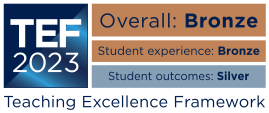
About the Teaching Excellence Framework (TEF)
The TEF is a national scheme run by the Office for Students (OfS) that aims to encourage higher education providers to improve and deliver excellence in the areas that students care about the most: teaching, learning and achieving positive outcomes from their studies.
Related courses
BA (Hons) Art and Design (Fine Art) Top-Up Degree (Level 6) - Full-time
Course Area:
Student Type:
Course Type:
Full-time University Level course
BA (Hons) Art and Design (Fine Art) Top-Up Degree (Level 6) - Part-time
Course Area:
Student Type:
Course Type:
Part-time University Level course