Potential Earnings
£73,657.00

A flexible higher‑education programme taken alongside work or other commitments, with a reduced weekly timetable and a longer completion time than full‑time study.
Not sure what this course level means? Use our course level explainer to help guide you through the different levels.
The tuition fee is per year.
Various bursaries are available for some Higher Education courses.
This university course is available through Clearing. You can find out more through our Clearing page.
Apply through ClearingThis new Bachelor of Engineering (Honours) top-up programme is ideal if you have a full Level 5 qualification and wish to develop your award to a full Bachelor's degree.
It has been designed to prepare you for a career in an industry where there's a high demand for engineers with a sound knowledge of engineering applications, as well as people who understand the necessary techniques to develop, test and maintain them.
This course is awarded by The Open University.
Applicants will already hold (or be expected to achieve) a full Level 5 qualification in a related subject area.
The BEng (Hons) Engineering (Electrical and Electronic) Top-up will support you to develop the knowledge acquired in your Level 5 studies, getting you up to the standard that employers are demanding when selecting candidates for professional engineering management roles.
Our Top-up programme teaches management techniques, research and project management skills, operations management and much more. As part of the course, you’ll be working on a live brief, giving first-hand experience of problem-solving in a real work environment.
Engineering graduates are in high demand and professional opportunities exist in many different fields such as construction, textiles, defence, renewable energy, food, aerospace, medicine, radio, TV and motor sport. There are also many kinds of engineering disciplines including civil, structural, mechanical, electronic and materials engineering and the type of work can vary from research and design to consulting and manufacturing.
Course Accreditation
This is being sought from the Engineering Council (www.engc.org.uk) the regulatory body for the UK engineering profession.
The Engineering Council sets and maintains internationally-recognised standards of professional competence and commitment.
Indicative modules:
3 modules – 2 core and 1 specialism.
Core modules:
Engineering Project (60 credits)
10,000-word Dissertation. Students will further develop research and management skills, consolidation of knowledge and understanding, and application of strategies and plans.
Using project management principles, leadership and team dynamics, quality assurance and risk management, statistical analysis and probability, numerical methods and computational techniques and research methods.
Systems Engineering (30 credits)
Reflective Journal and Project Report . Students will contribute to employer development through generating and managing a work-based action project.
This would be to develop a strategy or physical entity which contributes to efficiency and/ or workplace practice on sustainability, social or environmental justice.
Specialist Learning (30 credits)
Exam/ Essay. Students will develop and evidence research design and methodology, data collection and analysis, and academic writing. The specialist topics are expected to cover:
Facilities
Our modern Highfields campus features industrial-scale manufacturing, lathe and milling workshops, robotic machinery, fabrication and sheet metal workshops, electrical training bays, CAD and other design software on high end PCs, 3D printers and other design and manufacturing machinery, as well as a popular café/refectory, HE communal spaces and a well-stocked library and learning resource centre.
Timetable (subject to change)
The current timetable is as follows but this is subject to change:
Please note: Some classes may be delivered online.
Useful links:
2 years
Bachelor of Engineering (Honours) in Engineering (Electrical and Electronic) awarded by The Open University.
Applicants for this course will have already passed (or expect to achieve) a full Level 5 qualification in a related subject area. This could be a Foundation Degree (FdEng, FdSc, FdA), Higher National Diploma (HND), Diploma of Higher Education (DipHE) or similar qualification worth a minimum of 240 academic credits at undergraduate level.
GCSE English Language and Maths passes at Grades 9 to 4 (previously A* to C) are required. As an equivalent, we expect applicants to be working at (or to demonstrate competency at) Level 2 or above in English/literacy and Maths/numeracy.
A wide variety of innovative and traditional methods will be used including: practical assignments, portfolios of evidence, data analysis, case studies, written reports, essays, presentations, work-based evidence with employer statements.
Graduates will be well-placed for a career in the engineering sector or to progress to postgraduate studies.
Skilled electrical and electronic engineers are in high demand and can find employment in almost every sector of modern industry including energy, manufacturing, transport, communications, electronics, and health industries.

Nottingham College is approved by The Open University as an appropriate organisation to offer higher education programmes leading to Open University validated awards.
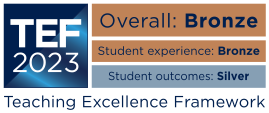
The TEF is a national scheme run by the Office for Students (OfS) that aims to encourage higher education providers to improve and deliver excellence in the areas that students care about the most: teaching, learning and achieving positive outcomes from their studies.
Select career:
Potential Earnings
£73,657.00
Average Earnings
£47,447.50
Source: Office for National Statistics' Annual Survey of Hours and Earnings (ASHE).
The number of job postings in this career for previous years starting from 2023, the current year and projections for future years until 2034.
Sources: The Labour Force Survey (LFS), Working Futures (projections) data, and Business Register and Employment Survey (BRES).
Engineering
Reading Comprehension
Active Learning
Mathematics
Critical Thinking
Active Listening
Economic data for careers is provided by Lightcast and also available through our Career Coach app. Job postings, employment and earnings information is represented at the regional level for the East Midlands.
Course Area:
Student Type:
Course Type:
Full-time University Level course
Course Area:
Student Type:
Course Type:
Full-time University Level course
Course Area:
Student Type:
Course Type:
Part-time University Level course