Potential Earnings
£73,657.00

A flexible higher‑education programme taken alongside work or other commitments, with a reduced weekly timetable and a longer completion time than full‑time study.
Not sure what this course level means? Use our course level explainer to help guide you through the different levels.
The tuition fee is per year.
Various bursaries are available for some Higher Education courses.
This university course is available through Clearing. You can find out more through our Clearing page.
Apply through ClearingIf you’ve completed a relevant HNC this conversion course can help you progress your career in Electrical and/or Electronic Engineering.
Electrical engineers are sought after worldwide across the private and public sector, from transport to healthcare, and education to construction.
We’ll develop your knowledge across a range of core and more specialist units. The course will suit you if you’ve completed relevant studies at an advanced level (A Level or equivalent) or have relevant industry experience and want to pursue a career in electrical and/or electronic engineering.
The course contains significant project-based learning including: laboratory investigations, design work, projects, case studies and tutorials.
You’ll undertake independent study and practical problem-solving alongside more traditional methods such as tutorials. You will develop your communication skills and the application of computers in engineering.
Core units:
Specialist units:
What are HTQs?
Higher Technical Qualifications (HTQs) are new or redesigned Level 4 and 5 qualifications (such as HNCs and HNDs) that have been approved against occupational standards in their sector. These qualifications have been developed by UK awarding bodies, working with employers and businesses to make sure that students get the specific training, knowledge and skills they need for their chosen career.
Timetable (subject to change)
The current timetable is as follows but this is subject to change:
Please note: Some classes may be delivered online.
You can view the full Course Specification here.
Nottingham College is proud to have been awarded the Teaching Excellence Framework Bronze Award for high quality student experience and outcomes. You can read more about this on the Office for Students website.
2 years
Pearson HND Electrical and Electronic Engineering for England (HTQ)
You should have successfully completed the following:
Mature students are welcome to apply but will still need to meet the entry criteria. If applying from another institution please note that the HNC qualification has to have the same specification as the one at Nottingham College.
Assessment is through assignments.
The HNC/D qualification is widely recognised in its own right and provides students with the skills required for employment in a broad range of industries with either a managerial or technical bias.
After successfully completing the HND you could top up your qualification with our new Level 6 BEng (Hons) top-up degree (subject to validation) or a similar course at a wide range of HE providers.
Alternatively you could pursue a career in research and development, design, technical sales and production.
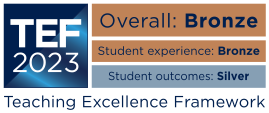
The TEF is a national scheme run by the Office for Students (OfS) that aims to encourage higher education providers to improve and deliver excellence in the areas that students care about the most: teaching, learning and achieving positive outcomes from their studies.

Select career:
Potential Earnings
£73,657.00
Average Earnings
£47,447.50
Source: Office for National Statistics' Annual Survey of Hours and Earnings (ASHE).
The number of job postings in this career for previous years starting from 2023, the current year and projections for future years until 2034.
Sources: The Labour Force Survey (LFS), Working Futures (projections) data, and Business Register and Employment Survey (BRES).
Engineering
Reading Comprehension
Active Learning
Mathematics
Critical Thinking
Active Listening
Economic data for careers is provided by Lightcast and also available through our Career Coach app. Job postings, employment and earnings information is represented at the regional level for the East Midlands.
Course Area:
Student Type:
Course Type:
Full-time University Level course
Course Area:
Student Type:
Course Type:
Part-time University Level course
Course Area:
Student Type:
Course Type:
Full-time University Level course